Welcome to the Thoreau Farm Trust!

Subscribe to our newsletter:

Make a Donation
leaf

Farming in Concord

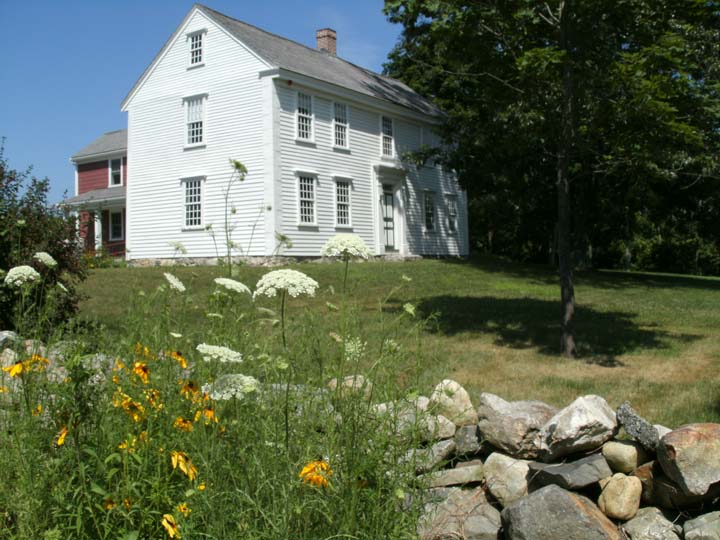
[The Thoreau Farm Trust has as one of its special concerns the history of farming in Concord. Concord historian Ruth R. Wheeler half a century ago wrote about farming in an article published in the Concord Journal on July 16, 1953. Mrs. Wheeler and her husband Caleb H. Wheeler from 1916 to 1953 owned and operated the dairy farm where the Thoreau birth house stood until it was moved in 1878. They called it Thoreau Farm. Mrs. Wheeler in 1942 was a founder of the Thoreau Society and, with Gladys Hosmer, spearheaded the campaign in the 1950s to preserve Walden Pond as it was in the days of Emerson and Thoreau. The article was published with an Alfred Hosmer photograph of Ephraim Wales Bull.]

Farming

By Ruth R. Wheeler

The principal industry in Concord has always been farming, but there has been a steady decline in the percent of the population engaged in this work.  For the first century and a half, every householder was also a farmer. The minister had his cattle and cut his own hay, as did the tavern keeper, the judge, the storekeeper and the shoemaker.

Dr. Ripley as a farmer is described by Emerson: “One August afternoon when I was in his hay field  helping him with his man to rake up his hay, I well remember his pleading almost reproachful looks at the sky, when the thunder gust was coming up to spoil his hay. He raked very fast, then looked at the cloud, and said, “We are in the Lord’s hand; mind your rake, George” and seemed to say, “You know that this field in mine – Dr. Ripley’s – thine own servant!”

We have always marveled at the stone walls raised by these pioneers, but consider that they had 250 years in which to do it. The common vehicle for this purpose was the stone boat pulled by oxen. This was simply two or three heavy planks bolted together and was at ground level without wheels, the front end shaped to clear the ground. The wall-sized stones were pried with crow-bars onto this useful tool and dragged to the nearest edge of the field where they were disposed of by piling into a wall. For labor, there was the farmer himself, his sons or his neighbor’s sons with an occasional indentured servant. For the biggest tasks work was exchanged with the neighbors but there was never an item for labor in the farmer’s account book – if he kept accounts. There was never an item for fencing either, since what animals were not kept in by stone walls, were allowed to run loose or were shut into small yards surrounded by wooden fences. Getting out the wood for fencing, new buildings, and for fire-wood was one of the principal tasks of the year. It occupied several weeks in the winter.

The facts about the size of the farm operations are somewhat surprising. The assessors list of 1717 (80 years after the founding of the town), shows a remarkable equality in the amount of possessions. There were then 293 polls with real estate valued at 4,854 pounds and 14 shillings. The personal property tax was called “faculty” and was levied only on the larger farms and the few merchants and artisans, there were 25 of these.

The Blood farms north of town were assessed at 34 pounds, 15 other farms were assessed from 20 to 30 pounds, all the others were less. The largest number of cows on any one farm was 12, the largest number of sheep, 20, and of oxen six. Several farms had two or three horses, probably used for riding rather than as draught animals.

Bear in mind that these cows gave milk for only a few months in the year. Most of the milk was skimmed for butter making. Sometimes the milking, and almost all the butter making, was women’s work. The crops were also scaled to the size of the family and for the stock, onions, corn, and wheat, apples and some barrels of cider were in every root cellar, squash in every attic. An idea of what is necessary can be obtained from old wills where a husband was providing for his widow. Jacob Baker reserved for his wife Grace the following: “Seven bushels of rice, seven of Indian corn, one of malt, 120 lbs. pork, 100 lbs. beef, both well salted, 2 bbls. cider, 6 lbs. flax, firewood, and a sufficiency of sauce of all kinds in the several seasons of the year, also a horse to ride to meeting.” Sauce was garden sauce, or vegetables.

For cash crops, few indeed were the products which could be sold for money. The account of the insolvent estate of Peter Bulkeley, Esq. (member of the governors council and grandson of the first minister) throws some light on this. He shipped horses to the West Indies, sold onions to a merchant in Charlestown, but through this merchant, he imported a sword and periwig, and a book or two, which somewhat offset his credits.

However, the farmer could never go hungry and needed very little cash. Even if he were unable to pay his taxes, they could be worked out by supplying oxen for the roadwork or timbers for bridge repairs. The blacksmith and the physician liked to be paid in money but often waited until an estate was settled to get their bills paid, meanwhile, of course, their own farms kept them supplied with  food and clothing so they could afford to wait. In Peter Bulkeley’s case the chief creditor was both a blacksmith and physician. It is amusing to read in his claim to the estate (1688) that Dr. Jonathan Prescott asked several pounds for medical attention and several pounds for blacksmithing. Whether or not this bill was ever paid Jonathan Prescott collected in full measure by marrying the widow.

After the Revolution the picture gradually changed.  The simple manufacturing done in one room or shed of the owner’s house was expanded to a shop, perhaps on the mill dam or opposite the church green or in a shed  or ell adjoining the owner’s house where several apprentices could be employed. The depression and unemployment following the Revolution made it easy to find workmen, and the patriotic desire to cut off importations from  Britain helped to start new industries but as far as possible the shop owner continued to run his farm and supply his own table.. The growth of Boston did give a good market for firewood, for timber, and for ship supplies, casks of salt meats, the barrels themselves.  David Buttrick is said to have paid for his farm by hauling wood, and many others are known to have made the long trip to Boston by ox sled.  This was a long journey at two miles an hour or with a very fast horse might be four miles an hour.

When the railroad was built on 1844 a new era began. There was a new market for milk and butter, a new market for wood and vegetables. The railroad and the new immigration brought a large number of hard workers here. Now began the era when the large barns were built, 20 to 40 cows were housed together – the farm horse began to replace the ox – and the local farmers club began to study new products.

Simon Brown was a prime mover in this field. He had been a newspaper editor in Hingham and a Representative in Washington and after he settled on his Concord farm he edited the “New England Farmer.” He had access to all the reports of the U.S. Department of Agriculture and constantly worked to put the new ideas in practice through the Farmer’s Club. The minutes of that Club were preserved by his granddaughter, Miss Grace Keyes, and could prove valuable to anyone who would undertake to write a history of agriculture in Concord.

The Middlesex Society for the Promotion of Agriculture held its annual cattle show which increased interest in new varieties.

The Concord Grape is the most famous product of this period. It has made the name of Concord known in many places where our battlefield and our great writers are unknown. John B. Moore was another pioneer in grapes, flowers and corn, with several new products to his credit.

The most prosperous of all our farming days came with the development of the greenhouse.  The Anson and Frank Wheeler farms were famous and farmers everywhere were cheered by the gossip that one lucky crop paid for a new glass house. Prosperity came to the strawberry and asparagus farmers, McHugh, Magurn, Dalton, Burke, Prescott, George and Wilfrid Wheeler were the well-known names of the day.

Just as great a revolution has taken place in the last 50 years although we sometimes are not aware of a gradual change which takes place before our very eyes. Fifty years ago J. B. Prescott of Bedford was picking up cans of milk for later sale to Somerville or Boston. His horses would stop at 20 farms on a two mile circuit. Today the dealer’s milk truck would find only two of those farms making milk. Each farm has specialized, raising either milk or eggs or vegetables as a principal crop. If milk is the crop, the high costs make large herds necessary, and good production essential. The best cow our fathers owned would be culled out of the herd as a poor producer today. One cow today must produce what three cows gave only 50 years age. The era when cows were forced by feeding western grain is being replaced by an era when green pastures, artificially watered, keep up production all summer and silage is fed in quantity in winter. The meadow hay once considered so good would not be touched by a modern cow. There are no horses to eat it either. The land which oxen could plow must be cleared of stones for the tractor. The stone walls are tipped into deep trenches to make the fields larger for the machine age.

The same is true of the hen: Where once every farm had a flock of about one hundred  hens, now a few farms each has its thousands. Where once a hen could lay 50 eggs, she must now lay 200 to keep her head.

The vegetable grower who once had half his farm in asparagus now finds that that crop requires too many man-hours to harvest and bunch, and the acre of land must produce two crops a year. Concord once raised more asparagus than any other town in the United States. Now only a few acres are left. Where every farm once raised strawberries in Concord, only a few are now raised.

The growth of refrigeration has completely changed the marketing picture. High prices for early grown products are a thing of the past. Eighteen dollars a bushel used to be the first price of asparagus and the big Boston clubs gladly paid a dollar a quart for the first fancy strawberries. The vegetable farms have turned to quantity production, to machine spraying, cultivating and packing. During the last three years there has been a revolution in watering. Some farmers have used irrigation from the town water supply in a limited way, now ponds are scooped out with bulldozers, gasoline pumps are installed and pipes are easily joined and moved by a new kind of coupling and are made of light weight metal. The engineers, paid by the U.S. government under the Soil Conservation Act, are busy every day planning the location of ponds, making test borings to find enough water, and supervising the machine work. They have also planned miles of drainage canals and other soil improving practices.

It has been a favorite pastime of farmers to estimate what a drought or an early frost has cost them. Thousands of dollars in damage is a common report from a farmer who never counted his profit in hundreds. Irrigation may rob them of this fun, but gives them instead a steady supply of salable vegetables. Good packaging is also rapidly becoming a necessity. Led by the efficiency of the Andy Boys Farms, other vegetable specialists are using washing machines, cellophane and mechanical tyers to put out an attractive package.

The farmers’ wives may be seen down town buying vegetables and butter, having no variety at home to choose from.

Farming is still an important business and if there were any statistics I think that they would prove that more is being produced both in dollar volume and in number of packages than ever before, though the per cent and the number of farmers has steadily declined. The small farmer, that is, the one raising a variety of products in small quantities, still exists, but much of his income comes from the retailing of his own produce on a roadside stand.

Farmers get around more now and learn more rapidly from their own observation under the leadership of the Extension Service. The Green Pastures program sponsored by the Extension Service, in a scant ten years has literally changed the face of the landscape. Pastures before the war were brown, bushy fields supporting a half dozen cows on 20 acres. Now these cows can be fed on the lush green clover on six acres. The influence of the Extension Service is also visible in every other branch of farming, but make no mistake about it, the successful farm still requires a Man

Thoreau Farm Trust • PO Box 454 • Concord, MA 01742 • Tel. 978.369.3091 •