Where Thoreau was Born
by Joseph C. WheelerJoseph C. Wheeler
Thoreauvians know that Henry David Thoreau was born on Virginia Road in Concord, Massachusetts, as he said, “in the very nick of time.”[1] In 1997 the Town of Concord bought Thoreau’s birth house and some twenty acres, saving the land from development. The Thoreau Farm Trust, a nonprofit citizens group, is negotiating with the Town to restore and manage the house. In this article I will consider the importance to Thoreau of this house and of one of the men who owned it, Captain Jonas Minot (1735-1813).[2]
Thoreau’s grandmother, Mary Jones (1748-1830), married the Rev. Asa Dunbar (1745-1787) in 1772. After her husband died in 1787, at the age of forty-one, Mary remained in Keene, New Hampshire. Eleven years later, in 1798, she married the widower Captain Jonas Minot of Concord, Massachusetts. By this time the youngest of Jonas’ nine children was nearly twenty. Mary brought her own children with her to live on the farm with her new husband. Mary’s daughter Cynthia Dunbar, who became Thoreau’s mother, lived on the Virginia Road farm some fourteen years before her marriage in 1812 to John Thoreau. After Jonas Minot died in 1813, Mary Minot asked Cynthia and John Thoreau to take over her “widow’s third” of the farm, but they left it in 1818, less than a year after their son Henry David Thoreau was born there. Jonas Minot was the only father Cynthia knew, since her own father died a month after her birth.[3]
Lemuel Shattuck, in his History of the Town of Concord, speaks of the Minots as a distinguished family going back to Thomas Minot, Secretary to the Abbot of Walden in Essex.[4] Thomas was Jonas Minot’s great-great-great grandfather. When Thoreau in his Journal quoted Shattuck on this he understandably added an exclamation point after the word “Walden.”[5] By coincidence the Walden we all associate with Thoreau received its name from his step-relatives!
Thomas Minot’s son George, born in 1594, and Jonas’ great-great grandfather, came to New England among the first settlers of Dorchester. He had four sons: John, James, Stephen and Samuel. John Minot (1626-1669), Jonas’ great grandfather, in turn, had four sons: James, John, Stephen and Samuel. This James Minot, who was born in 1653 and was Jonas’ grandfather, attended Harvard and came to Concord about 1680. Shattuck tells us that he preached in Stow, Massachusetts, in 1685, for twelve shillings six pence per day “one half cash and one half Indian corn.” He “practiced physic, was a captain, justice of the peace, representative [to the Massachusetts "General Court" or house of representatives] and, eminently, a useful man.”[6] He died in 1735.
Here I must explain that the story of the Concord Minots is also a story of Concord Wheelers. There were a number of Wheelers among the early settlers of Concord: George Wheeler, Obadiah Wheeler, Lt. Joseph Wheeler, Capt. Thomas Wheeler, Timothy Wheeler and Sgt. Thomas Wheeler. The relationship among these Wheelers is not completely clear but it is understood that Capt. Thomas Wheeler (a hero of King Philip’s War) and Timothy Wheeler were brothers and Sgt. Thomas Wheeler was their nephew.[7] (Incidentally, Charles Stearns Wheeler of Lincoln, whom Thoreau knew at Harvard, was a direct descendant of Sgt. Thomas Wheeler.)
Concord’s Capt. James Minot, Jonas’ grandfather, married Rebecca Wheeler (1666-1734), the daughter of early settler Timothy Wheeler (c.1601-1687). Timothy Wheeler, among other things, had come to own the mill in Concord. (The shopping area at the center of Concord is still called the “Milldam,” this being where the settlers had dammed the brook and established their first mill.)
Timothy Wheeler, who died not long after Rebecca’s marriage, left her the mill in his will.[8] This made the James Minot family among the more prosperous inhabitants. Of course the definition of prosperity has evolved through the years. An assessors report done in 1717, the oldest assessors report remaining in Concord’s records, valued their estate at about forty pounds, half in real estate and the rest consisting of one horse, two oxen, five cows, nine sheep and “faculty.” “Faculty” was assessed for tradesmen and blacksmiths and in this case presumably covered the equipment for the mill). That property put the Minots, in wealth, among the top ten percent of Concord’s citizenry.[9]
James and Rebecca Wheeler Minot had ten children. The fifth of these was also named James (1694-1759) and Shattuck called him “one of the most distinguished men of his time. He was a military officer about thirty years, and advanced to colonel, justice of the peace, representative, and a member of the King’s Council”[10]
The tenth child of James and Rebecca Wheeler Minot, was Samuel Minot (1706-1766) who married Sarah Prescott. Samuel and Sarah had three children: Samuel, Jonas and Thankful. Sarah Prescott was a granddaughter of early settler George Wheeler. Thus Jonas was directly descended from two of those early-settler Wheelers, with both George and Timothy his great-grandfathers. In a second marriage to Sarah’s younger sister, Samuel had five more children. Like his father, James, and his uncle Samuel, this younger Samuel Minot was a prominent citizen, serving as a deacon and captain and as a member of the Board of Selectmen from 1756 to 1758 and again in 1762.[11]
I turn now to the previous ownership of the land where Thoreau was born and this takes us back to those “early-settler” Wheelers, specifically to Sgt. Thomas Wheeler (1625-1704) who obtained substantial land in Concord’s East Quarter in what were known as the first and second “divisions.” The area is about two miles from the center of town. He thus became the first European owner of the land where Thoreau was born several generations later. Sgt. Thomas Wheeler married Sarah Meriam (died 1677) who was the daughter of Joseph Meriam (1630-1677). Joseph Meriam owned the house at what became known as Meriam’s Corner, made famous on the nineteenth of April in 1775 by the Yankee farmers who, following the encounter earlier in the morning at the Old North Bridge, began there the harassment of the British troops that continued all the way to Boston.
Sgt. Thomas and Sarah Meriam Wheeler had ten children, among them John (1655-1736) and Timothy (1667-1718) who each received from their parents large parcels of land on Virginia Road: John got the land where Thoreau was born and Timothy the land further up the street where his handsome saltbox house still stands. When John Wheeler died, his property was left to his widow (his second wife, Sarah Farwell Jones) and his children. Later, the estate sold the property to their cousin, Deacon Samuel Minot. The deed mentioned a home and barns on the property. This is the basis for the suggestion [13] that the Thoreau birth house might be dated from 1678 when, it was speculated, Sgt. Thomas Wheeler would have built the house for son John’s wedding to his first wife, Sarah Stearns. But this is apparently not the case.
We know that Deacon Samuel Minot did not buy the John Wheeler property for himself. Since his first son would inherit the family home on the Bay Road (now Lexington Road) Samuel apparently wished to buy the Virginia Road property for his second son, Jonas. He quickly conveyed the property to Jonas “for love and affection.” It now seems likely that in doing so he replaced the John Wheeler house on the property at the time he purchased it with a new house built about 1759 when his second son Jonas married Mary Hall of Westford. [15] This “new” house is the Thoreau birth house.
Jonas Minot and Mary proceeded to have nine children. Jonas was an active citizen in Concord. As early as 1762, when only twenty-seven, he was appointed by the Town Meeting as a constable. The position of constable was not particularly desirable since it involved collecting taxes from the neighbors. The town records tell us that “for his sarvis (sic) as constable [he was paid] the sum of five pounds nine shillings and two pence.”[16] In 1765 the Town Meeting appointed Jonas as “Culler of Staves & serveyer of bords, Shingles & Clabords.”[17] In 1767 Jonas Minot was appointed by the Town Meeting as a member of the Board of Selectmen (as the town council is called in New England). He served until 1770.[18] To carry out one of the duties of the Board, in 1768 Jonas was selected to “meet such as May Legally appear to Perambulate Between Concord & the Towns of Lincoln and Bedford the Eighteenth Day Instant.”[19] (This was an annual ritual to assure that the adjoining towns knew and agreed on the boundaries.) In view of his record of leadership it is not surprising that when, in 1775, tension was building between the citizens and Governor Gage in Boston and the Town Meeting decided to appoint a “Committee of Safety,” Jonas Minot was one of the nine men selected for this critical role.[20] After the war Jonas continued to be appointed by the Town Meeting to positions of trust.
Jonas Minot had properties in New Hampshire. He apparently owned most of what is now Wilmot, New Hampshire. We can speculate that his frequent trips to see his properties may have put him in touch some years after the death of his first wife with the widow Mary Jones Dunbar, then living in Keene.
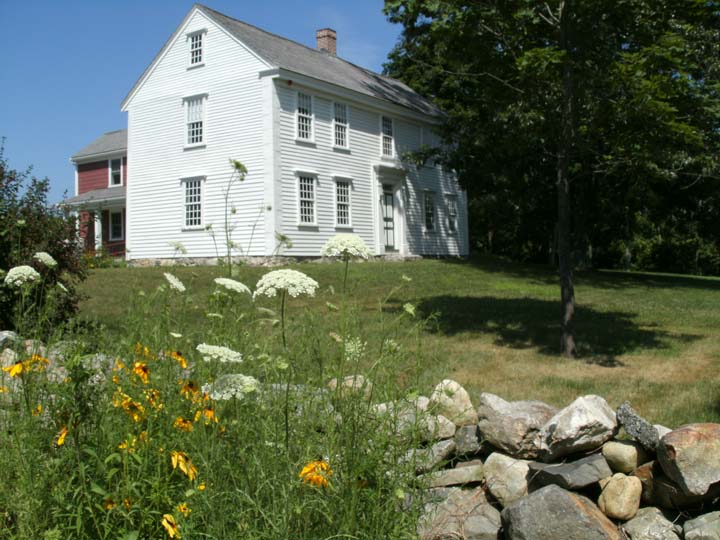
If we are right that Samuel Minot built the Thoreau birth house for son Jonas’ wedding to Mary Hall in 1759, the relative wealth of the family might explain the comparatively high style of the house, with its hand hewn quoins, its twelve over twelve windows with sculptural molded hoods and its beautiful door (described as having a “lavish denticulated cornice and elegant pilasters” and as being a “masterpiece of Georgian design and taste”).[21] It was a house built by a prosperous Concord farmer and landholder.
That Jonas continued to enjoy the relative prosperity of the Minot family is supported by a story told by the Society for the Preservation of New England Antiquities (SPINEA) which owns the Charles Barrett house in New Ipswich, New Hampshire. This stately mansion was built by textile mill owner (and former Concordian) Charles Barrett, Senior for his son at the time of his wedding to Jonas Minot’s daughter, Martha, in 1799. SPINEA cites the “tradition” that Jonas promised to provide furniture for “as large and fine a house as Mr. Barrett could build.”[22] The Barretts were a distinguished Concord family: Colonel James Barrett commanded the troops on the 19th of April in 1775. There had been earlier examples of marriages between the Barretts and the Minots and these close family ties clearly continued between the New Hampshire branch of the Barrett family and the Concord Minots.
Thoreau’s Journal reflects a number of supper table conversations Thoreau had with his mother, Cynthia, about her life on the farm with Captain Jonas Minot.
Of Captain Minott, mother says her father-in-law [step-father] used to roast and eat a long row of little wild apples reaching in a semicircle from jamb to jamb under the andirons on the reddened hearth, but he had a quart of new milk regularly placed at the head of his bed which he drank at many draughts in the course of the night. It was so the night he died, and my grandmother discovered his dying by his not turning over to reach his milk. I asked what he died of, and mother answered apoplexy! At which I did not wonder. Still this habit may not have caused it.[23]
Another time Thoreau writes:
My mother was telling tonight of the sounds which she used to hear summer nights when she was young and lived on Virginia Road – the lowing of the cows, or cackling of geese, or the beating of a drum as far off as Hildreth’s but above all Joe Meriam whistling to his team, for he was an admirable whistler. Says she used to get up at midnight and go and sit on the door-step when all in the house were asleep and she could hear nothing in the world but the ticking of the clock in the house behind her.[24]
Mother remembers the Cold Friday [January 19, 1810] very well. She lived in the house where I was born. The people in the kitchen – Jack Garrison, Esther, and a Hardy girl – drew up close to the fire, but the dishes which the Hardy girl was washing froze as fast as she washed them, close to the fire. They managed to keep warm in the parlor by their great fires.[25]
Again, Thoreau writes:
[I was] born July 12, 1817 in the Minott House, on the Virginia Road, where Father occupied Grandmother’s thirds, carrying on the farm. The Catherines [presumably Kathrens] the other half of the house. Bob Catherine and John threw up the turkeys. Lived there about eight months. Si Meriam next neighbor. Uncle David died when I was six weeks old. I was baptized in old M. H. [Meeting House] by Dr. Ripley, when I was three months, and did not cry.[26]
Thoreau himself, of course, never knew Jonas Minot but it is manifest that through his mother, father and grandmother Jonas had an important influence on him. His “step” relationship with the Minot family may well have opened doors to another descendant of the earlier James Minot: George Minot whose house stood on the ridge almost opposite the Emerson home which Thoreau frequented. Thoreau loved to write in his Journal of his frequent conversations with this old Concord farmer.[27]
The practice of leaving one-third of the estate to the widow was common. One wonders about the problems involved in dividing a single-family house into two or three parts. There is a document that describes the portion that went to Mary Minot in 1813 after her husband’s death. It says:
The front room and chamber over it in the east end of the House and one half of the front entry in common and the bed room in the north west end of the House and the cellar under the front room as far north as the cellar window then running West in a parallel line with the front of the house to the west side of the cellar with a privilige (sic) to pass and repass to it and a privilige in the kitchen and sink room equal to the 1/2 part in common and back yard and well also one half of the wood and chaise house and small room between the wood and chaise house and of laying and cutting wood in the wood yard end of the House and the passageway down to the lower well to be used in common.” Another statement adds: “…with a privilige in the kitchen to work and bake in the oven – also a privilige in the sink room and the bedroom in the west end of the house and the chamber of said bedroom to pass and repass out at the back door.”[28]
In 1818 the Thoreau’s gave up the farm and moved away from it. The house was sold and, several owners later, in 1878, for reasons we do not know, moved up the street. When it was moved, the back part that made it a salt box was removed and the central chimney was replaced. Later, electricity, heating and plumbing were added and the outside was changed by removal of the quoins and replacement of most of the windows and the front door. A small front porch was added. By the time the town acquired the house in 1997 it was seriously run down. Yet it retains important elements of the earlier house including a fine stairway, paneling and inside doors. Recently the house has been re-roofed and repaired to keep it from further deterioration during the several-year period required to plan the restoration and raise the necessary funding.
We know what the house looked like from a Mary Wheeler sketch of the house done in 1897. In her sketch the house is drawn as if it was in its original location. There is also an Alfred Hosmer photograph of the house taken a few years after it was moved, when it still had its quoins and twelve over twelve windows. The Thoreau Farm Trust hopes to restore the house to its condition at the time of Thoreau’s birth.
In 1916 my newly wed parents bought the farm where Thoreau was born. They called it Thoreau Farm. After the Thoreau birth house had been moved another house was built to replace it and I was born in this “new” house that, alas!, is already more that one hundred and twenty years old.. An old barn, there in my time but since demolished, may have dated back to the Jonas Minot period. I feel especially lucky to have been brought up where Jonas Minot farmed, and Cynthia Dunbar grew up. I have happy memories of our cows and chickens, of making hay and picking blueberries, of keeping the garden and cutting asparagus – memories not unlike those Cynthia spoke about to her journal-writing son.
My mother combined the roles of farmer’s wife and local historian and when the Thoreau Society was incorporated, it used our Thoreau Farm as its legal address. She later became a Vice-President of the Society and was a leader in the late 1950s campaign to preserve Walden Pond as it was in the days of Emerson and Thoreau. (This “Save Walden” campaign of the Thoreau Society resulted in the May 4, 1960 Massachusetts Supreme Court decision that the Middlesex County Commissioners, when they started an expansion of Walden’s bathing facilities, had violated the terms of the 1922 deeds of Emerson family members giving the property to the state.)
As it happened, my father, Caleb Henry Wheeler, was a direct descendant of both George Wheeler and Sgt. Thomas Wheeler, and thus was a distant cousin of the Minots, and my mother, who was brought up in Watertown, Massachusetts, shared with Thoreau descent from Lewis Jones. (Articles on the Jones family were republished in the Thoreau Society Bulletin in 1998.) My parents sold the farm in 1953 and the land has since sprouted many houses and trees. I believe they would be pleased that the town, with the help of many donors, has decided to preserve the farm next door where the birth house now stands.[29]
The Thoreau Farm Trust would like to use the house as a place to interpret and educate about the results of research it will do on the history of agriculture and land use in Concord over the past millennium. Thoreau lived in Concord midway between the first European settlement and today. This was a time when Concord’s trees were mostly cleared, making way for cultivation. Since Thoreau’s time, farming has lost its place in the local economy and most farms have gone back to forest or shrubs. Future generations must decide how they want the town’s landscapes to evolve. The Trust hopes its research will be helpful to this process.
The Trust particularly looks forward to the day when those who celebrate the life and works of Henry David Thoreau will be able to come to the farmhouse built for Jonas Minot and see the very room in which his step-grandchild, Henry David Thoreau, was born.
NOTES
1. The Journal of Henry D. Thoreau, edited by Bradford Torrey and Francis H. Allen, Houghton Mifflin, Boston, 1949, Vol IX, p. 160. back
2. The spelling “Minot” and “Minott” are both commonly used. back
3. Walter Harding, The Days of Henry Thoreau, Princeton University Press, 1992, Chapter 1. back
4. Lemuel Shattuck, A History of the Town of Concord, Russell, Odiorne and Company, Boston, 1835, p. 379 back
5. The Journal op. cit. Vol.X p. 219 back
6. Shattuck op.cit. p. 379 back
7. The Wheeler Families of Old Concord, Mass., George Tolman, 1908, reprinted by the Concord Free Public Library, 1970, 1981 back
8. Charles H. Walcott, Concord in the Colonial Period, Estes and Lauriat, Boston, 1884 p. 95. back
9. Ruth R. Wheeler, Concord: Climate for Freedom, Concord Antiquarian Society, Concord MA, 1967, Appendix E back
10. Shattuck, op. cit. p. 380 back
11. Shattuck, op. cit. p. 234 back
13. Ruth R. Wheeler, “Thoreau’s Houses”, manuscript in the Special Collections of the Concord Free Public Library back
15. Maximilian L. Ferro, “The Henry David Thoreau Birthplace, Concord, Massachusetts: A Report Prepared for the Town of Concord and the
Thoreau Birthplace Task Force”, December, 1998, p. 19 back
16. Records of the Town of Concord for 1756-1765, Special Collections, Concord Free Public Library, p. 215b back
17. Records op. cit. for 1765-1777, p. 254a back
18. Shattuck op. cit. p. 235 back
19. Records op. cit 1765-1777 p. 298a back
20. Records op. cit. 1765-1777 p. 416a back
21. Maximilian L. Ferro op.cit. p. 21 back
22. SPINEA leaflet on the Barrett House, New Ipswich, New Hampshire back
23. Journal, op.cit. Vol.XIV 329 back
24. Journal, op. cit. Vol.X, p. I38 back
25. Journal, op. cit. Vol IX, p. 213 back
26. Journal, op. cit. Vol. VIII p 64 back
27. Ruth R. Wheeler wrote in “Our American Mile”, Concord Antiquarian Society, 1957, p.16, of a conversation she had with George Minot’s niece, Mrs. John Moore, who said that young Ellen Emerson looked into the barn next to her father’s house one evening just as a cow had kicked George Minot. “For two cents I would sell you to the butcher”, said George Minot. A few minutes later Ellen came back with two pennies to buy the cow to save her from certain death and was intensely disappointed to learn that Minot had changed his mind back
28. Paper dated 1813 in a file folder called “Widow Mary Minot”, Special Collections, Concord Free Public Library back
29. Ruth R. Wheeler wrote Concord: Climate for Freedom, published in Concord by the Concord Antiquarian Society in 1967. I have written a paper called “Growing up on Thoreau Farm,” which is available in the Special Collections at the Concord Free Public Library. back
Joseph C. Wheeler is a charter member of The Thoreau Farm Trust. He served for five years as its first president and currently is clerk/secretary of the organization. This article is reprinted courtesy of The Thoreau Society, which published it in the 1999 edition of The Concord Saunterer.