Welcome to the Thoreau Farm Trust!

Subscribe to our newsletter:

Make a Donation

Mary Minot and the Thirds of Widow

by Leslie Perrin Wilson

Prior to the 20th century, a woman’s security and status hinged largely on the success or failure of the men in her life, particularly her husband. Under such circumstances, widowhood could be an economic and social as well as a personal catastrophe. Lacking effective means of self-support and deprived upon marriage of most of the legal rights associated with property ownership, a widow was protected to some extent by the English common law and early American practice of assigning “widow’s thirds” (also known as the “right of dower”), which assured her the use of a third of her deceased husband’s real estate for life, or until she remarried. (The right generally did not extend to personal property, the ability to own which a woman gave up when she married.)

While a man might provide amply for his wife in a will or through other means, she was guaranteed widow’s thirds even if her husband died without leaving a will, as was frequently the case. Well into the 19th century, in Concord as elsewhere, the right of dower was often all that stood between a widow and homelessness.

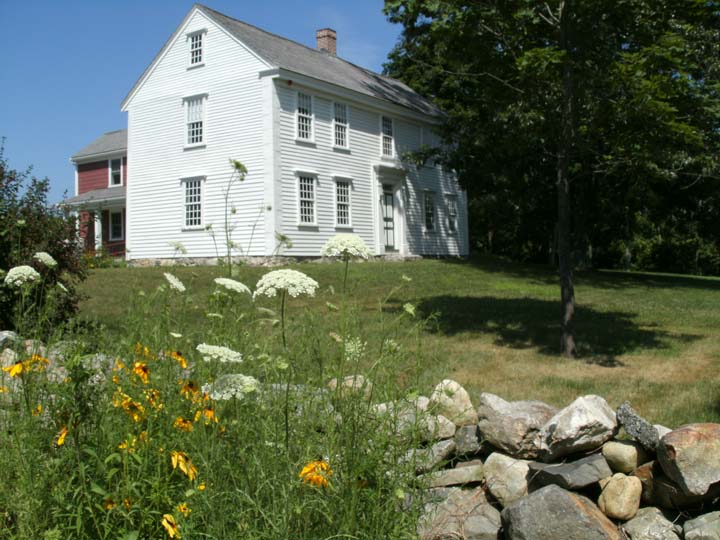
Henry David Thoreau, one of Concord’s best-known natives, was born in 1817 in the present 341 Virginia Road, in a room within the widow’s thirds of his grandmother, Mary Jones Dunbar Minot (Minott), widow of Captain Jonas Minot. A document dated April 17, 1813 in the Concord Free Public Library Special Collections defines the scope of Minot’s thirds in detail, specifying the east chamber on the second floor-where her grandson came into the world a few years later-as part of her dower. The recent signing of a purchase and sale agreement between the Town of Concord and the Thoreau Farm Trust for the purpose of ultimately restoring and meaningfully using the Thoreau birth house gives this document fresh importance in Concord’s social and literary history.

Born in 1735, Thoreau’s step-grandfather Jonas Minot was a prosperous farmer, a landowner in and beyond Concord, a descendant of 17th century Concord families (Wheeler as well as Minot), a town official (constable and selectman), and an officer during the Revolution. In 1759, he married Mary Hall, with whom he had nine children. The first Mrs. Minot died in 1792. In 1798, Jonas Minot took as his second wife the fifty-year-old widow Mary Jones Dunbar of Keene, New Hampshire. The new Mrs. Minot brought to the Virginia Road household the children of her first marriage to the Reverend Asa Dunbar, who had died in 1787. Her young daughter Cynthia Dunbar-born just before her father’s death, later the wife of John Thoreau and mother of Henry David Thoreau-thus spent a significant part of her early life on the Minot farm.

Jonas Minot died on March 20, 1813, leaving Mary Jones Dunbar Minot once again a widow. The boundaries of her widow’s thirds were established less than a month later. They were recorded with minute precision, revealing the preference of our forebears to trust in agreements and contracts rather than in the good will of their fellow human beings in clarifying potentially ambiguous property situations. In this, the document in the Library Special Collections is similar to many others like it, which not only specify the demarcation between the widow’s and the heirs’ portions of house, barn, outbuildings, and land, but also spell out the rights of way permitted the various parties and any other privileges (use of hearth, oven, well, and sink, for example) accorded the widow.

Old documents characteristically describe property in terms of landscape features which have long since lost their familiarity. The land that was Mary Minot’s to use was defined in relation to “the Mill yard … Road across the Meadow to Reuben Browns land … the ditch to land late of Capt. Stephen Jones … land of Capt. Bates … the onion garden-meadow … land of Wm. Mercer … land formerly of Eben[eze]r Stow … land of Mather Howard … the fence at the top of the hill … the brook … the little orchard so called … the back pasture adjoining the House … a stake at the end of the wall … the old barn … the top of the great rock … the new Barn … the bars by the lower well,” and so on. The fact that the Jonas Minot farmhouse was moved to its present location in 1878 from the site of the house now numbered 215 Virginia Road further complicates understanding of the exact boundaries delineated.

Leaving nothing to chance, the document explicitly grants Jonas Minot’s heirs the right “to pass and repass with cattle teams and otherwise through said bars by the lower well” and to traverse in the course of normal farm operations (carting dung and watering cattle, for instance) other areas designated for the use of Mary Minot.

The Widow Minot was assigned the “front room & chamber & Garret over it in the east end of the House and one half of the front entry in common and the bed room in the north westward of the House and the celler under the front room as far north as the celler window then running west in a parrelel line with the front of the House to the west side of the celler with a priveledge to pass and repass to it and a priveledge in the kitchen and sinkroom equal to 1/3 part in common.” Her dower included use of the back yard and the well, too, and “one half of the wood & Chaise house & … laying and cutting wood in the wood yard east of the House the door yard in front and at the west end of the House.” She had kitchen, oven, and sink privileges, as well, and the right to go out by the back door.

Such specificity placed the respective rights of widow and heirs above the vicissitudes of family relations. Still, it is unclear how easily enforced a widow’s rights were in cases where there was bad feeling between the parties involved.

After Jonas Minot’s death in 1813, his personal property was auctioned. For whatever reason, Mary Minot chose not to take advantage of her widow’s thirds of his real estate. Perhaps farm life in a location remote from the village center simply lacked appeal for a woman of sixty-five. She mortgaged her share of the farm to Josiah Meriam and rented and lived in part of what is now 201 Lexington Road. She later repaid the mortgage, which allowed her daughter Cynthia, son-in-law John, and their growing family to move into the farmhouse. But John Thoreau found it difficult both to farm on the outskirts of Concord and to keep store in the town center. In March of 1818, when Henry David-or David Henry, as he was named-was eight months old, the Thoreaus left Virginia Road, and rented another part of the house where Mary Minot then lived. They remained there a short time before moving to Chelmsford. Not long after they left Virginia Road, the farmhouse was sold to settle Jonas Minot’s estate.

Perhaps not coincidentally, Mary Minot’s grandson would later use the concept of widow’s thirds metaphorically in his writings. Thoreau wrote in “Chesuncook” (a chapter of The Maine Woods), for example: “These Maine woods differ essentially from ours. There you are never reminded that the wilderness which you are threading is, after all, some villager’s familiar wood-lot, some widow’s thirds, from which her ancestors have sledded fuel for generations, minutely described in some old deed which is recorded, of which the owner has got a plan too, and old bound-marks may be found every forty rods, if you will search.” In relation to the landscape, Thoreau here and elsewhere applied the term “widow’s thirds” to suggest neglected areas once cultivated, not genuinely wild, less powerful than true wilderness.

Widows in Massachusetts today fare somewhat better than they did in Mary Minot’s time. Now when a man dies intestate, his widow is entitled to a larger and more encompassing share of his estate-personal as well as real-than was then standard.

Despite their widow’s thirds, Mary Minot and many of her contemporaries struggled in widowhood, their dowers insufficient to ensure a tolerable quality of life. The Library Special Collections include a poignant letter written in 1815 by the Reverend Ezra Ripley of the First Parish to solicit financial aid for Mrs. Minot from the Masons. Ripley wrote: “[In] the settlement of the estate of her … husband, Jonas Minot … she has been peculiarly unfortunate, and become very much straightened in the means of living comfortably; … individual friends have been … generous, otherwise she must have suffered extremely; … being thus reduced, and feeling the weight of cares, of years and of widowhood to be very heavy, after having seen better days, she is induced by the advice of friends, as well as her own exigencies, to apply for aid to the benevolence and charity of the Masonic Fraternity.” Only later in the 19th century would women’s legal and economic status begin to improve.

Copyright 2004 L.P. Wilson.

Leslie Perrin Wilson is Curator of the Concord Free Public Library Special Collections, a writer on local historical and literary topics, and a regular contributor to The Concord Journal, where this article first appeared. She is on the Advisory Board of the Thoreau Farm Trust.

Thoreau Farm Trust • PO Box 454 • Concord, MA 01742 • Tel. 978.369.3091 •