Celebrating Another July 12 Milestone At Thoreau’s Birth House
by Lucille StottOn Monday, July 12, at 4 p.m., the Thoreau Farm Trust and the Town of Concord will celebrate the signing of a purchase and sale agreement for the 18th-century farmhouse where Henry David Thoreau was born – on July 12, 1817.
It’s an exciting moment. After a year of planning and negotiation, the town has agreed to sell the house and two acres of surrounding land to the Thoreau Farm Trust for $1 as soon as the Trust has raised the necessary funds to rehabilitate and restore the house, which was placed this year on the National Register of Historic Places.
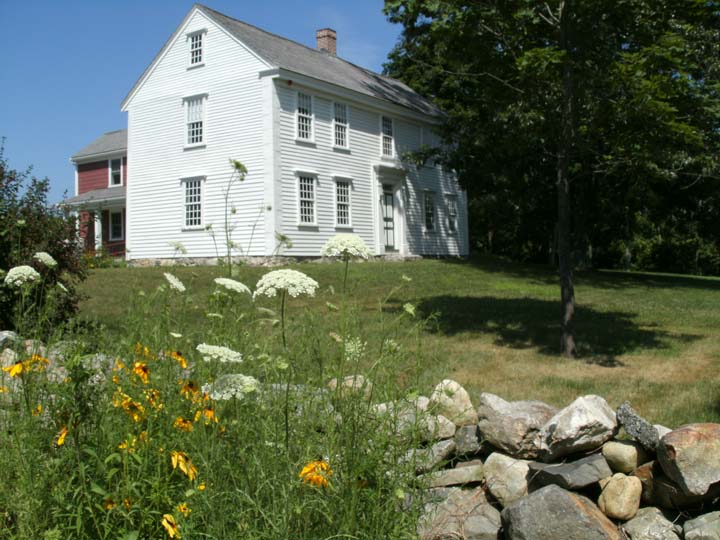
Originally located at what is now 215 Virginia Road, on a large farm owned by Henry’s grandfather, Jonas Minot, the house was moved in 1878 and now stands at 341 Virginia Road on twenty acres that were part of the original farm.
This beautiful farmland was preserved and the historic farmhouse saved from possible destruction by a town purchase in 1997. The $960,000 used for the purchase included only $160,000 of town funds. The remainder was raised through major contributions from state, corporate and foundation grants, the Educational Collaborative for Greater Boston (EDCO), Massport, and many private citizens.
I remember well the 1997 Town Meeting, when a wave of orange ballots signaled overwhelming approval of the purchase after a presentation by Sally Schnitzer, then chair of the Board of Selectmen. Sally said the town would use the land to continue the important farming tradition at the site; to provide a place for citizens to enjoy the rural atmosphere; and to honor the legacy of Concord’s most famous native son through the restoration and rehabilitation of his birth house and modest educational programming.
Those raised ballots were an enthusiastic recognition of the hard work of many people: members of the Breen family, who owned the house at the time; Doris Smith, a neighbor who first alerted The Concord Journal to potential development; Tom Blanding, the eminent Thoreau scholar, who helped establish the historic value of the house and land; Town Manager Chris Whelan, who navigated the town through the process; and several devoted advocates, including then – Selectman Judy Walpole, Helen Bowdoin, Joe Valentine, Court Booth, Jack Green of EDCO, and Joe Wheeler, who was born in the house that was built at 215 Virginia Road after the birth house was moved.
The successful purchase was also a model of public-private partnership that continues to this day. Acreage at the site has been leased to Gaining Ground, the local nonprofit farm organization that grows and harvests food for the hungry. In this way, the property’s long farming tradition has been preserved and the public has enjoyed access to the open land.
Determining the future of the house has been a more complicated process, in part because it is a historic structure in need of major rehabilitation. After the purchase, the town put out a call to private citizens to find a way of rehabilitating the house and providing educational programming. The Thoreau Farm Trust, a nonprofit, volunteer citizens’ group, was born in response to that call.
The Trust’s first plan involved a partnership with EDCO, a respected educational organization and a major contributor to the purchase through a donation from the Seefurth family, whose patriarch sought a place to teach younger generations about Thoreau and his legacy. The Trust proposed to lead a fundraising effort and plan the house restoration, while EDCO offered to erect an adjacent barn and oversee educational programming. When in 2001 negotiations between the town and EDCO broke down over proposed uses of the barn, the Trust lost its partner. It then decided to suspend its own plans and seek alternative ways to proceed.
A fresh opportunity presented itself in 2003, when the town issued a new Request for Proposals for the house and its two-acre lot, and the Thoreau Farm Trust decided to step forward once again. This time, we were greatly aided by the expert advice and practical help of BayTrust, Inc., a recently formed nonprofit development company based at Clock Tower Place in Maynard. With the advocacy and support of BayTrust’s president, Joseph Mullin, and vice-president, Patricia Marcus, the Trust negotiated a successful purchase and sale agreement, prepared cost estimates for the rehabilitation and restoration of the house and the construction of a barn, and engaged top-notch historic preservationists to guide in the development of construction and re-use plans.
A solid year of hard work—and enormous help from Concord’s Planning Director Marcia Rasmussen and her associate, Carol Kowalski—led to the June 28 Board of Selectmen vote to sign a purchase and sale agreement.
So, who is the TFT, where do we go from here, and what value will all this have for Concord?
The Thoreau Farm Trust is currently composed of ten board members, all volunteers with a strong interest in Thoreau and the history of this agricultural property: Joe Wheeler, our founding president and a past president of the Concord Historical Commission, is now our clerk/secretary; Court Booth, director of Concord-Carlisle Adult and Community Education, is our vice president; John Mack, a member of the Historical Commission, the Mill Brook Task Force, and the Thoreau Society board, is our treasurer. Other members are Helen Bowdoin, Land Conservation Coordinator at the Walden Woods Project, Jayne Gordon, executive director of the Thoreau Society; Michael Kellett, executive director of RESTORE: The North Woods; Brian Donahue, director of Environmental Education at Brandeis Univeristy; Barbara Lambert; a historic preservation consultant and resident of the Thomas Riggs House in Gloucester; and Tim Rodgers, a software engineer, Virginia Road resident, and board member of Gaining Ground. I am currently serving as president.
Last fall, we asked Molly Eberle, a Concord resident with extensive development and community service experience, to serve as our part-time executive director.
The purchase and sale agreement stipulates that the Trust must raise the funds to rehabilitate and restore the house—$800,000—before taking title to the property. That is where we go from here.
But the Trust’s overall vision involves a more comprehensive plan and a total fundraising goal of $2.2 million. That plan includes the construction of a barn to serve as an educational center, the implementation of modest educational programming about the history of agriculture in Concord and the legacy of Henry Thoreau; a landscape design that maintains the rural aspect of the property, and the beginning of an endowment to ensure future maintenance of the house, barn, land, and programs.
Why is all this important, especially in a town that already celebrates Thoreau in important ways, most notably at Walden Pond, at The Concord Museum, and in the Special Collections of the Concord Free Public Library? Throughout its years of exploration, the TFT has benefited from the support and advice of representatives of these and other historical sites in town as well as the Walden Woods Project in Lincoln. We have learned that there are, in fact, important roles this property can play.
Currently, there is no place in Concord to celebrate the rich agricultural history of the town, and we feel we have the perfect spot to do this. The house – identified on the National Register as the Wheeler-Minot Farmhouse/Henry David Thoreau Birth House – has a long agriculture history that preceded and followed Thoreau’s lifetime. It provides an ideal setting for placing Thoreau and his work in the context of his family, his community, and his connection to and strong interest in the town’s farming tradition. One of the Trust’s major goals is to provide materials at the site that trace the evolution of agriculture in Concord, with Thoreau’s lifetime as the important pivot. We also intend to include in our landscaping design plans for small house gardens reflecting historic farming practices. And because Gaining Ground continues to cultivate the land, visitors to the house will have the opportunity to experience a working farm.
In addition, the barn will be used in part as a place where students and teachers can gather to discuss a visit to Concord’s historic sites. Right now, there is no place for this to happen comfortably, so Thoreau Farm will fill an important niche while complementing—not duplicating—programming that already exists.
My work with the Trust has always been grounded in my belief that there must be a place in Concord a simple, unassuming place—where Thoreau’s full life, not just the part he spent at Walden Pond, can be celebrated in the modest way he lived it. By purchasing the house and part of the farm where he was born, the people of Concord paved the way for this to happen in the agricultural landscape he knew so well.
Thoreau’s birth 187 years ago on July 12 was a humble beginning, as all births are. I hope you will join us on July 12, 2004, for another humble beginning, as we set out to give new life to Thoreau Farm.
Concord resident Lucille (Daniel) Stott is a freelance writer and editor and a former editor and managing editor of The Concord Journal. A shortened version of this commentary was published in the July 8, 2004 issue of The Concord Journal.